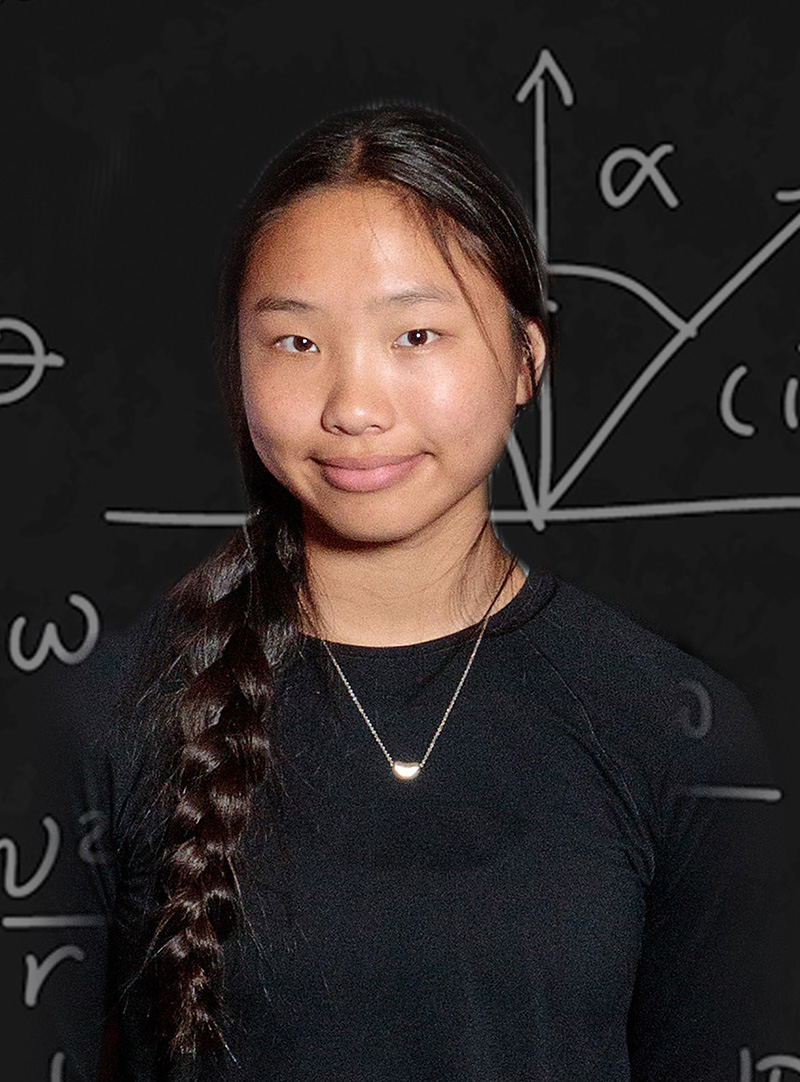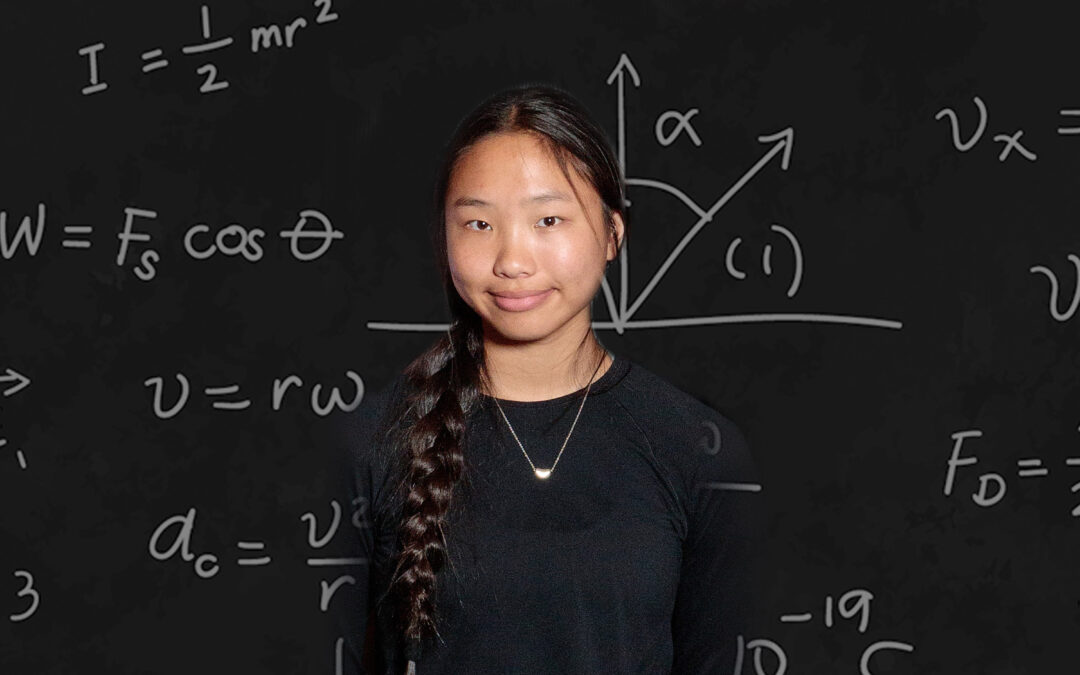
Claire Lu talks about on her experiences at AwesomeMath, where she studied “Algebra 1.5.”
“My first week of AwesomeMath Algebra 1.5 showed me that the course is very different from traditional Algebra 1, despite the similar name. The class builds on the math courses I have already taken at my high school, but the problems are not simply using a standard formula and plugging in specific numbers. Instead, most of the problems require trying different approaches before finding one that works. Oftentimes, I would think of an idea and work through a couple of steps before realizing that I had reached a dead end, requiring me to circle back and find a different pattern. The questions needed us to justify each step, so the challenge was proving reasoning instead of solely arriving at the correct result,” Claire reports.
“One topic that stood out to me was symmetric and cyclic factoring because I had never worked with it before and it taught me to not jump into solving a problem but to instead look for patterns first. A symmetric expression remains unchanged when any two variables are exchanged. For example, x² + y² + z² is symmetric because swapping a, b, and c does not change the expression. A cyclic expression, on the other hand, only remains unchanged when the variables are rotated in order, such as x²y + y²z + z²x. Replacing (x, y, z) with (y, z, x) gives the same expression. Some can be both symmetric and cyclic like xy + yz + zx. Identifying these patterns helped to save a significant amount of time. For symmetric expressions, proving a result for x meant that the argument automatically applied for y and z, while in a cyclic expression, finding one factor such as (x-y) indicated that (y-z) and (z-x) were also factors,” Claire explains.
“I also liked the way the problem sets were designed because each lesson included many questions, but we were only assigned a small number each day. This gave us enough time to work carefully through the required problems while still leaving additional questions if we wanted more practice. At the end of the week, I received a 70% on Test 1. I did not finish every question, but I earned at least partial points on all of them because I showed my thinking and wrote down the steps I attempted. After a few days, the teaching assistant returned the exams with written comments and hints for the problems left unfinished, which I then used to complete the remaining questions,” Claire adds.
Week 2 — Learning different approaches to math solutions.
Claire reports that during her second week at AwesomeMath, her way of thinking about math had begun to change. “I became more determined when facing difficult problems and was more willing to keep trying different approaches instead of giving up when the solution was not immediately clear, Claire says.
The course covered three major inequality tools during the second week: the Cauchy-Bunyakovsky-Schwarz Inequality, Titu’s Lemma, and the Rearrangement Inequality.
“The Cauchy-Bunyakovsky-Schwarz Inequality gives a way to compare sums of products with sums of squares. For two sequences, it states that (a₁b₁ + a₂b₂ + … + aₙbₙ)^2≤(a₁² + a₂² + … + aₙ²)(b₁² + b₂² + … + bₙ²). For example, using the sequences (a.b) and (1,1) gives (a + b)² ≤ 2(a² + b²). We also learned that the expression often has to be rewritten before the inequality can be used. If a term appears as 2x, it may be helpful to rewrite it as x + x so that the number of terms matches the structure required for the problem,” Claire says.
“Titu’s Lemma is a specialized form derived from the Cauchy-Schwarz Inequality that is especially useful for fractions. It states that (a₁²)/(x₁)+ (a₂²)/(x₂)+⋯+aₙ²/xₙ≥((a₁ + a₂ + … + aₙ)²)/((x₁ + x₂ + … + xₙ)), as long as the denominators are positive. For example, a^2/x+b^2/y ≥ ((a + b)²)/((x + y)). This allows several fractions to be combined into one lower bound instead of being handled separately,” Clair explains.
“We also studied the Rearrangement Inequality, which compares different ways of pairing two ordered sequences. Pairing the largest term in one sequence with the largest term in the other sequence gives the greatest possible sum of products. Pairing the largest term with the smallest gives the least possible sum. For example, with the sequences 5, 3, 1 and 6, 4, 2, the sum 5·6 + 3·4 + 1·2=44 is the largest arrangement, while 5·2 + 3·4 + 1·6= 28 is the smallest,” Claire adds.
“This course improved my algebra skills by reviewing concepts I had not used in a while while also introducing new topics. I am extremely grateful to the Garwin Family Foundation for giving me the opportunity to participate in this program; I truly could not have done it without their support,” Claire says.
“All in all, my biggest takeaway from AwesomeMath was learning to be comfortable with not reaching perfection immediately. Many of the problems could not be solved in one clean attempt, so I had to begin with an incomplete idea and improve it step by step. An unsuccessful attempt was not wasted effort because it usually showed me what did not work and gave me a better direction for the next try. The most important thing is simply to try. As Norman Vincent Peale said, ‘Shoot for the moon. Even if you miss, you’ll land among the stars,'” Claire reports.
We are happy to hear that you enjoyed your time at AwesomeMath, and were able to learn new math skills and concepts. Great work, Claire!
>> Read Claire Lu’s final report (PDF File, 103 KB)
>> Learn about the other students’ experiences in the GFF Scholarship Program.