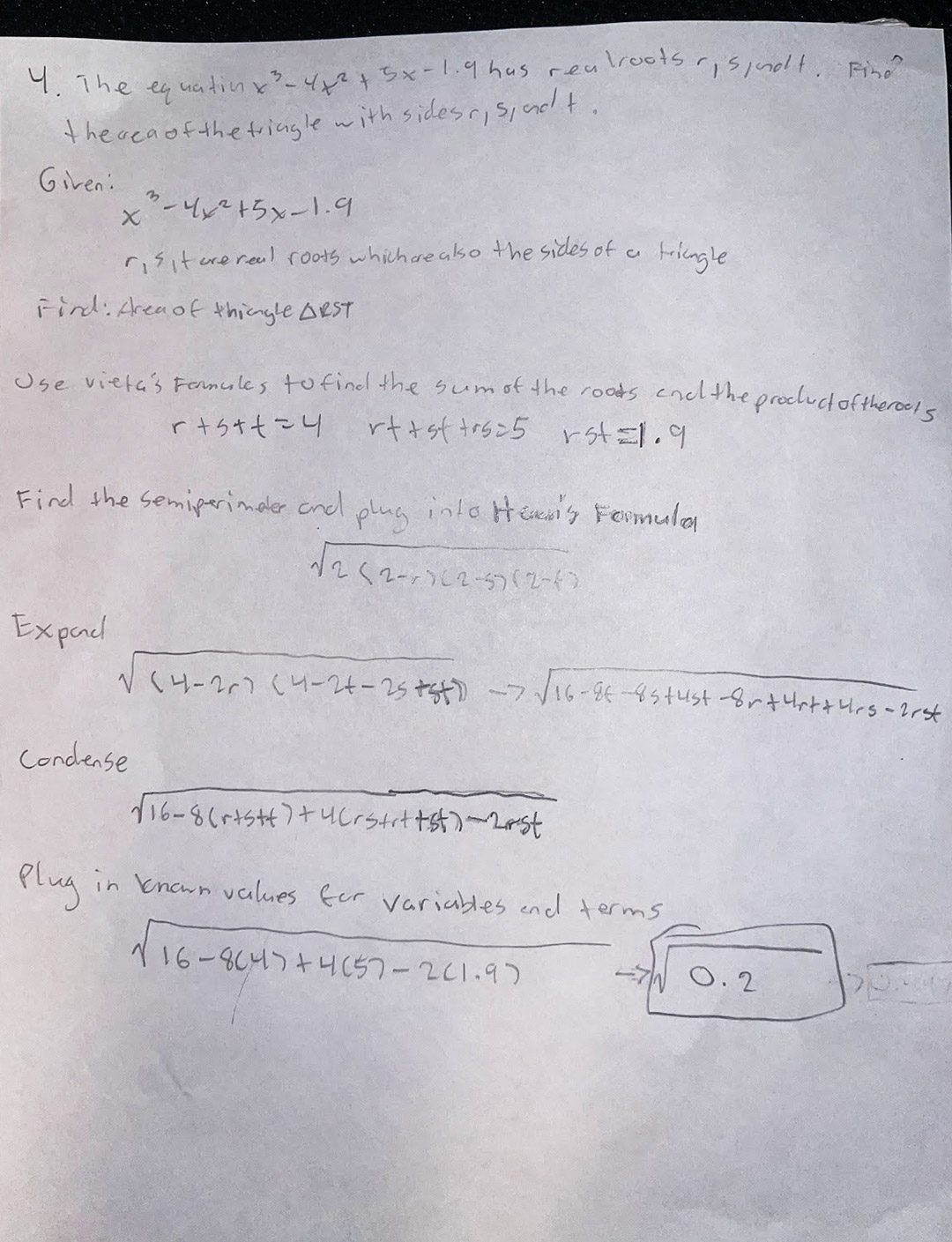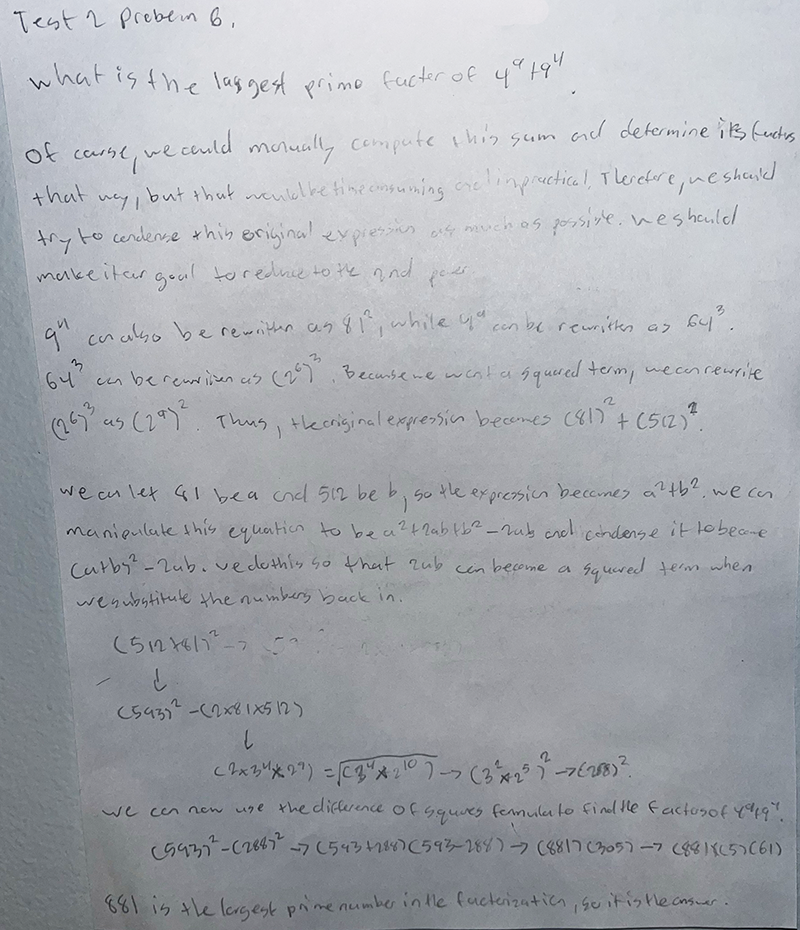
David Johnson reports on his first week at AwesomeMath, where he is studying Algebra 2.5. David says that his first week was “very rigorous and stress-inducing, but that does not distract from the enjoyment of achievement that it left me with after its completion.”
“AwesomeMath, briefly, is an online intensive mathematical course where enrolled students can learn various topics such as number theory, combinatorics, geometry, and algebra from professors around the world and engage in meaningful discussions with students around the world. I applied for the Algebra 2.5 course, because I had just finished Algebra 2 at my high school, and I wanted to prepare early for the precalculus course I will take next year,” David explains.
David says his first day began with a Zoom call and included student introductions to break the ice.
“I learned that some kids were as close as Connecticut, but others were as far as India and Korea. In addition, I learned that other kids shared some of the same hobbies as my own; for example, one kid liked playing soccer, which was a major hobby of mine,” David adds.
“During the lecture, we primarily discussed the Fundamental Theorem of Algebra, which states that every polynomial with complex coefficients has complex roots. The professor wrote on an interactive whiteboard, which we also utilized during our problem-solving sessions, which I thought was a great idea for participation. He moved at a decent pace, and he always followed up by asking for questions after each new topic or problem,” David reports.
“During the problem session, we were given a problem set to work through for about thirty minutes, which we would then discuss with the class after. It was nice to see how other students worked through problems that I was either stuck on or I didn’t get to see interpretations on solving problems that have rather simple solving techniques,” David adds.
Students were able to schedule sessions with their professor and/or TAs for additional help and encouragement in solving the assigned math problems, which David found helpful.
“We were given roughly ten problems for homework. They ranged in difficulty from fairly easy to fairly challenging. That first day, I managed to get through all the easy ones and a couple of the medium ones, which I was proud of. The TA reminded me to try the harder problems even when I think I couldn’t solve them. I found this to be very valuable advice, and it taught me to not back down from problems that challenged me,” David reports.
“As the week continued, we delved into more concepts like Vieta’s Formulas, Newton’s Sums, and manipulating polynomials. Vieta’s Formulas allow you to find the sum and product of the roots without even knowing the roots themselves. Newton’s Sums attributed these properties to variables which made it easy to solve more complex equations,” David adds.
“To conclude the week, we were administered a test to complete, which would be an assessment of our understanding of the topics we learned throughout the week. It was only six questions, but they encompassed the entirety of the material we learned in that first week. I didn’t find it to be as hard as I thought it would have been, and I managed to answer three with confidence and give my best shot on two more,” David says.
When not in class, David was able to participate in activities including soccer practice, the gym, and playing piano in his free time. “AwesomeMath also held social events where we had the opportunity to play games like chess with other people in the program. These opportunities were effective at mitigating the stress that came with the program,” David adds.
“All in all, the first week was stressful, but I enjoyed the challenge. I never would have really thought I would gain a slight liking for competition math, but this program so far has proved me otherwise,” David says.
Week Two — Trigonometry
David reports on his second week at AwesomeMath. “I became more accustomed to the expectations, and I found strategies to extract more benefit from the program,” David says.
“On Monday, we covered a topic that I was extremely familiar with thanks to Algebra 2: trigonometry. The lecture covered many of the same trigonometric functions that we learned in class, but the professor went into detail about why these identities actually work. The professor taught us how to derive these identities, which made the homework, in my opinion, the most straightforward to me it has been the entire course. I managed to get through more than half of the problems, which I hadn’t been able to do as often as the previous week,” David reports.
“Tuesday was very similar to Monday in terms of the material; we built off what we learned the previous day, including complex numbers in trigonometry. We also caught a glimpse on how to graph the complex numbers, which we would dive into in further detail the next day. I also discovered that you can use Euler’s number to create a complex relationship between trigonometric functions and coordinates on the imaginary plane. I had only learned about Euler’s number at school in logarithims, so it was cool to see how the number applied to various applications. On the homework, there was a problem identical to one from the previous week, but I was able to actually understand how to do it the proper way due to my newfound knowledge of conjugates,” David explains.
“On Wednesday, we delved into the roots of unity, which I would argue was the most intriguing and fascinating topic I had learned so far in the course. The roots of unity simply explain that a number x, when raised to an n power and equals 1, has n points on the unit circle on the complex plane that form a polygon. For example, the coordinates of z^4 = 1 on the unit circle form a square, which indicates that z=1, z=-1, z=i, z=-i. The cool thing about this concept is that, as captivating as it is, it entirely builds on what I learned in Algebra 2, which I think is one of the most amazing parts about this program. The homework was one of the toughest ones yet, though, and I was only able to answer a few problems. Nonetheless, it was cool to see the concept in practice, and the day was certainly one to remember,” David adds.
“Thursday was just as astounding as the previous day, if not more. When I first listened in to the lecture, I was mind-blown at how easy the professor made the concept look. The professor taught us that we could find out the infinite sum of a geometric series as long as it converges, meaning the values that are added to the original number progressively get smaller and smaller infinitely. A geometric series is one where one term is divided by the one before it, and a common ratio exists. We also learned about finite arithmetic and geometric series that have a stopping point, but the infinite geometric series was the highlight, in my opinion. I learned that you can denote these sums with a sigma, which I thought was the perfect term for this concept,” David says
David ended the week with a lesson on how to manipulate and factor equations “out of the blue.” He also was able to practice soccer, and then study for his test the next day.
“The test the next day, to my surprise, was not as difficult as the one the previous week. In fact, two of the questions were almost identical to those in the homework, and I managed to get through them pretty quickly. Ultimately, I was satisfied with my performance,” David says.
Week Three — A Life-Changing Learning Experience.
David reports on his final week at AwesomeMath. “It is kind of crazy to think that three weeks can pass so quickly. I would be dishonest if I were to say that three weeks cannot really change your life. I learned so many skills and insights from this program that not only made my life clearer but made math, a subject that is so simultaneously intricate and complicated, have clarity as well. I not only gained a foundation from the new branches of math I was exposed to from my professor, but I learned that not every challenge needs to be solved at first glance. In fact, not every challenge needs to be solved at all. I discovered that there is no success without process, struggle, and failure. Success, and more importantly, growth, does not come with a detour,” David explains.
“I would say the curriculum itself is the most fascinating part of this program and the part I enjoyed the most. Each day always had new content, but I was familiar with the roots of the lessons. Everything I learned had some background in Algebra 2, which I would say is the best part about this program. Vieta’s formulas allow you to find the sums and products of the roots of a polynomial without having to know the roots themselves; I learned about polynomials in Algebra 2, but I never learned about Vieta’s formulas there. In trigonometry, I learned the same trigonometric functions that I learned in Algebra 2, but I learned why these identities actually work. Later on in the course, we delved into the roots of unity, which considers Euler, a mathematician whom I learned briefly about in Algebra 2 with logarithms but not with the complex plane. Simply, the content I learned in this program added a new level of difficulty to what I already knew, which helped my understanding each day despite the underlying challenge,” David says.
“One thing AwesomeMath places much emphasis on is the rigor of the program. Each day, I found myself spending almost the entire day on each homework lesson, and some days I would not even be able to finish half of it. The tests would take me a long time too. Along with the comments from my professor and TA, I learned that the effort is expected but accuracy is not. This sort of ideology made each piece of work less intimidating, but the philosophy still helped me make progress in my understanding,” David explains.
“I would say the greatest takeaway and accomplishment I extracted from this program was the idea that stepping out of my comfort zone is necessary to succeed. In the summers in the past, I have taken many other programs, from topics ranging from coding to psychology and beyond. However, I realized that none of these programs I took were very significantly challenging to my own expectations. I felt like I got by rather than I truly got anything out of it. With AwesomeMath, on the other hand, there was not a single day when I would deem the content “easy”. I would rather call every day a learning experience. With the help of my professors and peers, I learned much more both about the content and myself than I had ever learned from other programs in the past,” David says.
“Aside from the fact that this camp is virtual, I would still definitely recommend this camp to future Garwin Family Foundation students. As part of this program, students will learn so much about math that they will not learn about in school. They will find out what it means to learn through struggle, but they will also learn to celebrate what they accomplish due to the struggle,” David adds.
“Going into this program, I was very unsure as to what career path I would like to pursue. Despite the mathematical challenges of this program, I feel more after this program that a major that incorporates math and challenges me in that way would be best for me, such as something like chemistry or neuroscience,” David says.
“I want to conclude by giving my utmost thanks and gratitude to the Garwin Family Foundation for such an amazing opportunity. Without their assistance throughout the entire process for this camp, I do not think I would have gained nearly as much experience, learning, and benefit. I would definitely recommend this program and GFF to any student seeking a challenge and to learn more about themselves,” David adds.
We are happy to hear that you enjoyed the course and were able to work through the challenging material. Good job, David!
>> Read David Johnson’s final report (PDF File, 35 KB)
>> Learn about the other students’ experiences in the GFF Scholarship Program.